


A senior leader at a 500+ person firm was working 70-hour weeks.
Stressed. Overwhelmed. Behind on strategic priorities.
When we reviewed their calendar, the problem became clear:
They were still reviewing all marketing materials, despite having a head of marketing.
They were still checking transaction details, despite having an accounting team.
They’d hired capable people. But they hadn’t actually delegated the work.
Here’s what happened: they stayed buried in operational tasks while strategic priorities—planning for the future of the business—got ignored.
Their team couldn’t grow because they were never given real responsibility. The leader became the bottleneck.
This isn’t unique. Leaders take on too much. They can’t let go. Their team can’t develop because they’re never truly empowered.
Today, I’m going to show you the 5-step process for delegating effectively—so you can free yourself up to focus on what only you can do.
Let’s dive in.
Step 1: List everything on your responsibility plate.
Most leaders don’t actually know what they’re doing.
They’re reacting to emails. Attending meetings. Solving problems. But they’ve never documented their full workload.
Start here: write down everything you’re responsible for.
Client relationships. Marketing reviews. Financial oversight. Team management. Strategic planning. Operational decisions.
Get it all on paper. You can’t delegate what you haven’t identified.
Step 2: Assess enjoyment and importance for each task.
Now evaluate each responsibility on two dimensions:
How much do you enjoy this work? (High or Low)
How important is it that you personally do this? (High or Low)
This creates four categories:
High Importance + High Enjoyment = Keep it. These are tasks only you can do and that energize you. Protect these.
High Importance + Low Enjoyment = Keep it (for now). These matter but drain you. Look for ways to systemize or eventually delegate.
Low Importance + High Enjoyment = Delegate it. You like doing it, but it’s not strategic. Give it to someone who can grow from it.
Low Importance + Low Enjoyment = Delegate it immediately. This work doesn’t need you and doesn’t energize you. Move it off your plate.
The pattern: if it’s not high importance AND high enjoyment, it’s a candidate for delegation.
Step 3: Determine who’s best suited to take it on.
For each task you want to delegate, ask: who on my team is the best fit?
Consider:
Who has relevant skills or experience? Look for natural matches based on their background.
Who would benefit from developing this skill? Delegation is a growth opportunity. Who’s ready to stretch?
Who has shown interest in this type of work? People perform better when they care about what they’re doing.
Don’t just delegate to whoever has time. Match tasks to people who can succeed and grow from them.
Step 4: Assess their capacity… time, interest, and ability.
Before you delegate, confirm three things:
Do they have time? Don’t pile work on someone already buried. Free up their plate first if needed.
Do they have interest? People resist tasks that feel forced. Make sure they see value in taking this on.
Do they have ability? Can they do this now, or will they need training? Be realistic about their readiness.
If any of these is missing, address it before delegating. Otherwise, you’re setting them up to fail.
Step 5: Create an action plan to transition the responsibility.
Delegation isn’t “here, you do it now.” That creates chaos.
Build a transition plan:
Define success clearly. What does good look like? What outcomes matter? Give them clarity upfront.
Provide context and training. Don’t assume they know your process. Show them how you’ve been doing it and why.
Set checkpoints early. Schedule reviews in the first few weeks to catch issues before they compound.
Transfer authority with responsibility. If they’re accountable for outcomes, give them decision-making power. Otherwise, they’ll keep escalating to you.
Step back progressively. Start with more oversight, then reduce it as they prove capable.
The goal: they own the work, not just execute tasks you assign.
What happened with that senior leader.
Remember the leader reviewing marketing materials and transaction details?
We walked them through this process.
They listed their responsibilities. Assessed what truly needed them. Identified team members ready to step up.
Then we built transition plans. Marketing reviews went to the head of marketing with clear criteria for escalation. Transaction oversight went to the accounting lead with defined thresholds.
The result: the leader freed up 15+ hours per week. They finally had time for strategic planning, looking at the future of the business instead of being buried in operations.
Their team grew too. The head of marketing gained real ownership. The accounting lead developed judgment on when to escalate vs. solve independently.
Delegation isn’t about getting out of work. It’s about doing work only you can do… and empowering your team to grow.
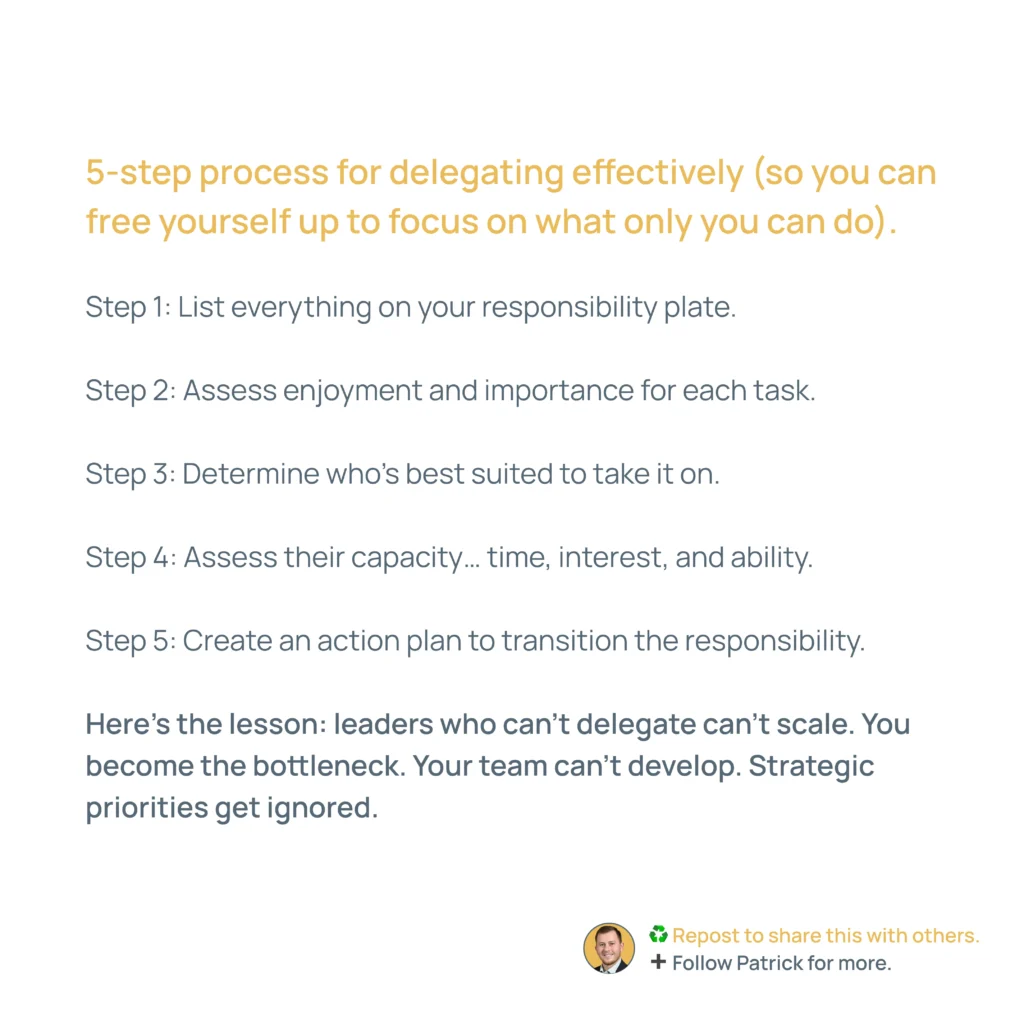
Here’s the lesson: leaders who can’t delegate can’t scale.
You become the bottleneck. Your team can’t develop. Strategic priorities get ignored.
Most leaders know they should delegate more. But without a process, it stays on the “someday” list.
The leaders who scale effectively follow this framework: they identify what’s on their plate, assess what truly needs them, match tasks to the right people, confirm capacity, and build transition plans.
That’s how you free yourself up to focus on what only you can do.
Whenever you’re ready, here are three ways we can help…
1. Strategy & Growth Blueprint: Market-grounded insights + an annual plan + a 90-day execution board your team owns.
2. Operations & Tech Reset: We map bottlenecks, design future-state processes, and build a phased tech roadmap ready to launch.
3. Manager+ Accelerator: We build core skills in delegation, feedback, goal-setting, and shape leaders who drive execution.